
This is the first of two connected articles. Part one looks inward, using my own experience with generative AI music to explore what creative effort, authorship and meaning actually feel like when the labour is removed. Part two steps back and asks a different question: what does history suggest might to happen next, once the novelty wears off and the wider culture moves on?
I decided to try one of the AI music systems that have been getting so much attention lately. In the name of experimentation I set up a free Suno account, which took a few minutes. Nothing complicated. I found the screen where you type in prompts, typed in “upbeat vocal house song with funky bassline”, added a deliberately clichéd line of lyrics (“get on the floor if you want more”) then pressed enter. That was it.
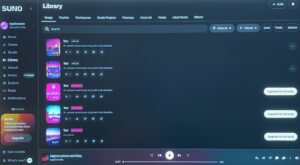
Within a minute or so Suno had created not one but three full, polished, commercial sounding house tracks – see the image of my Suno ‘library’ screen above. This is the sort of thing that not that long ago would have taken weeks of manual studio work, expensive equipment and a few arguments about side-chain compression. Now it came from a single prompt and a poor quality ‘lyric’ that took me five seconds to think up.
Initially I have to say I was quite impressed. The tracks sounded pretty good. They sounded perhaps a couple of years out of date, and a bit predictable, but were certainly convincing, and technically very well produced. I’ll link to the audio either here or in another post so you can check it out for yourself.
But very quickly this impression was replaced by a strange sense of hollowness. The track had a sort of external appearance that was convincing, but nothing of substance behind it. A strange analogy came to me: it was a bit like biting into a shiny plastic apple stuffed with feathers. This was nice creative output made with no creative effort, which raised a question that I’ve been thinking about a lot: if you did not do the labour – by which I mean sustained input, effort and judgement, making and revising decisions over time, rather than typing in a few prompt words – what claim do you really have over the result?
In other words, what does the result “mean”?
There is a very well known line from the Bhagavad Gita which states that “you have the right to your labour, but not the fruits of your labour”. This is usually read as encouragement to focus on the act of doing, in the moment, rather than obsessing over the outcome. But something more subtle is going on here with instant AI music (and other instant AI creations). If you obtain the outputs without the labour, do you have any rightful claim to the outputs at all? If not, what are they ‘for’ if they are intended to be considered as creative?
This is the contradiction at the heart of generative AI. The work appears instantly, sounding complete, clever and often indistinguishable from something created by humans. But it is not “yours” in any meaningful sense, because you did nothing to make it. There is no story, no reason why the thing had to be created, no judgement, no problem solving, no old-fashioned practice making perfect, or (in a lot of my own music making) simple trial and error. It’s a case of getting an instant answer to a question without doing any of the working out to get there, or skipping to the end without understanding how it links to the beginning.
This made me think about the nature of originality. AI music systems do not “create” anything in any human sense. They spot statistical patterns from enormous datasets of human made input material (in this case music recordings). They identify what tends to follow what, and recombine those elements into new shapes that mimic the patterns, and produce very convincingly something you recognise as “new”. This is impressive, but it is mimicry rather than creation. It’s a vast process of analysing existing material and recombining it into new shapes that feel familiar. The results can look ‘new’ with none of the gravitas of intention that normally gives creative work its meaning.
There is a philosophical analogy here: the Ship of Theseus. If every part of a ship is gradually replaced, is it still the same ship?
British readers may be more familiar with the same concept being treated in Only Fools And Horses as “Trigger’s Broom”. If you’re unfamiliar, here’s a YouTube clip. Scroll forward to around 2 minutes for the philosophical insights…
For AI the question becomes: if every part of a generated output is built from prior human work, but none of it is copied directly, is the output new or reconstructed? The answer depends entirely on what originality is itself supposed to mean. There’s a lot of legal and legislative context to this, but not much that simply and directly applies to this new context. Artistically, the question is more human: if you make no effort, can the result ever be yours?
Despite all of this, I do not think AI is a threat to creativity itself. AI is extremely good at exposing structure and patterns, which can be helpful. For example I’m not particularly great on song structure, which has long hindered my ability to get music finished. I get bored, I get stuck in the details, and sometimes find it hard to zoom out and see how a piece of music should feel across a longer timeline than the section I’m focussed on at any given moment. Seeing an AI interpretation of a style that I’m working in can give me useful reference points. It can also highlight weaknesses in my arrangements or production level that I might not otherwise notice. Used well, AI can raise your game by showing you what you have not yet mastered. But it cannot replace the act of mastering it.
What AI cannot do is provide the sense of meaning and satisfaction that comes from actually creating something. Creativity requires labour and the meaning sits inside the process, not the outcome. Even when the result is imperfect it carries the imprint of your decisions and your effort. AI generated output does not. It offers the fruits without the labour and for anyone who is genuinely creative that will never be enough. This is now termed “AI slop” – which, going back to the earlier analogy, you could say is perhaps less “Ship” Of Theseus, and more “Shit” of Theseus.
By mid-career, this distinction becomes easier to spot. You have gained enough experience to know that skill comes from repetition, from trying, failing and improving, and from taking the time to hone and develop an array of skills and awareness that you need to better your craft. The bettering of the craft is just as much a part of the craft as the outputs produced by it.
Mid-career experience has taught me that shortcuts are useful only when they help you make better decisions, not when they remove the need to make decisions at all, or perhaps worse make decisions for you. AI will be a powerful tool for quick ideas, structural guidance or reference material, but the danger is confusing the availability of instant output with the achievement of doing the work. My cheesy dance tune was very easy to tell apart as a thing I’d had no claim – or wish to claim – creative input over.
This is where the technology reveals something important about us. When you remove the labour you remove the identity. Something made with no effort has no story and no value beyond novelty. The real satisfaction comes from seeing your own judgement at work and watching the thing you made take shape. AI cannot replace that.
It also cannot change the reality that creativity is one of the few areas of life where effort and fulfilment are tightly connected. You do the work and the work shapes you. You learn something about yourself each time. There is value and some pride in that, even when the results are modest. AI generated music does not have that sense of self in it, which is why listening to those perfectly formed house tracks felt empty. They were technically competent, but without any human story there was no connection. I suppose it was “music”, but only in the sense that they were digital files containing sets of audio waveforms making up fairly generic and anonymous melodic sound pieces. Music is more than this.
This technology is not going away, nor should it. Used well it will help creators reach higher standards and find new ways to learn. But the part that makes work meaningful is still human. Hours spent trying to come up with new melodies that engage and interact with other parts, getting them to sit properly and work together, the dead ends, the breakthroughs, and the constant fight against boredom, resistance, motivation and fear of committing to complete things and get them out into the world. That is where the life of creativity sits, and that is what AI cannot touch.
The law around AI generated music rights, practices, ownership and many other aspects are unsettled and evolving quickly. Several principles are beginning to take shape, although none of them are definitive yet.
– Copyright law generally requires a human author and some degree of originality. Many AI outputs will fail that test unless there is meaningful human input during the creative process.
– There are active disputes over whether training AI systems on copyrighted music is lawful. Technology companies tend to rely on text and data mining exemptions or fair use arguments. Rights holders argue that their labour is being exploited without consent. Rights holders have adopted similar tactics to those deployed in the old days of file sharing: litigation followed by commercial deals.
– Courts in the UK, US and EU are beginning to apply older copyright doctrines to AI, including questions of substantial copying, originality thresholds and authorship. Not much of this has settled into a clear general position.
– For those interested in the legal landscape, the UKIPO consultations on AI and copyright and the EU’s text and data mining provisions are a good place to start.
From a personal perspective, my strong advice to creators is to treat AI outputs as reference material or tools. They can be very good guides, frameworks and navigational aids, but you simply have to put in the time, effort and skill needed in order to claim the final result as your own.
AI can produce a perfect sounding track in the time it takes to scroll through your social feed to get a quick dopamine hit. What it cannot produce is the part that matters: the meaning that comes from doing the work. Creativity has always been about more than the result. It is about the process, the decisions made along the way, and the part of yourself that becomes visible in what you make.
AI will make some things easier, and it has a lot to teach us. But it won’t by itself make any meaningful contribution to any artistic discipline. As long as our response to human creativity relates to origin, motivation and context of the work, and not just how it sounds or looks superficially, then creativity will remain an entirely human domain. It may be one of the clearest ways in which we recognise what it actually means to be human.
In part two we’ll have a look at where this might be going next.